Fisiologia - Funções Secretoras do Trato Alimentar (Capítulo 65) PARTE 1│ GUYTON
Functions of Secretory Glands in the Digestive System
Overview of Digestive Functions
- The lesson introduces the topic of secretory functions within the digestive system, building on previous discussions about digestive control mechanisms.
- The instructor mentions that this session will focus on secretion, with a promise to release additional content related to motility later.
Types of Glands in the Digestive System
- Two main types of glands are identified: those involved in digestion and those providing protection.
- Digestive glands produce enzymes and substances like hydrochloric acid and saliva, while protective glands secrete mucus to safeguard the digestive tract.
Protective Mechanisms
- The stomach has a thick mucus layer to protect its lining from digestive juices; similarly, the duodenum secretes bicarbonate to neutralize incoming acids.
Cellular Structure and Function
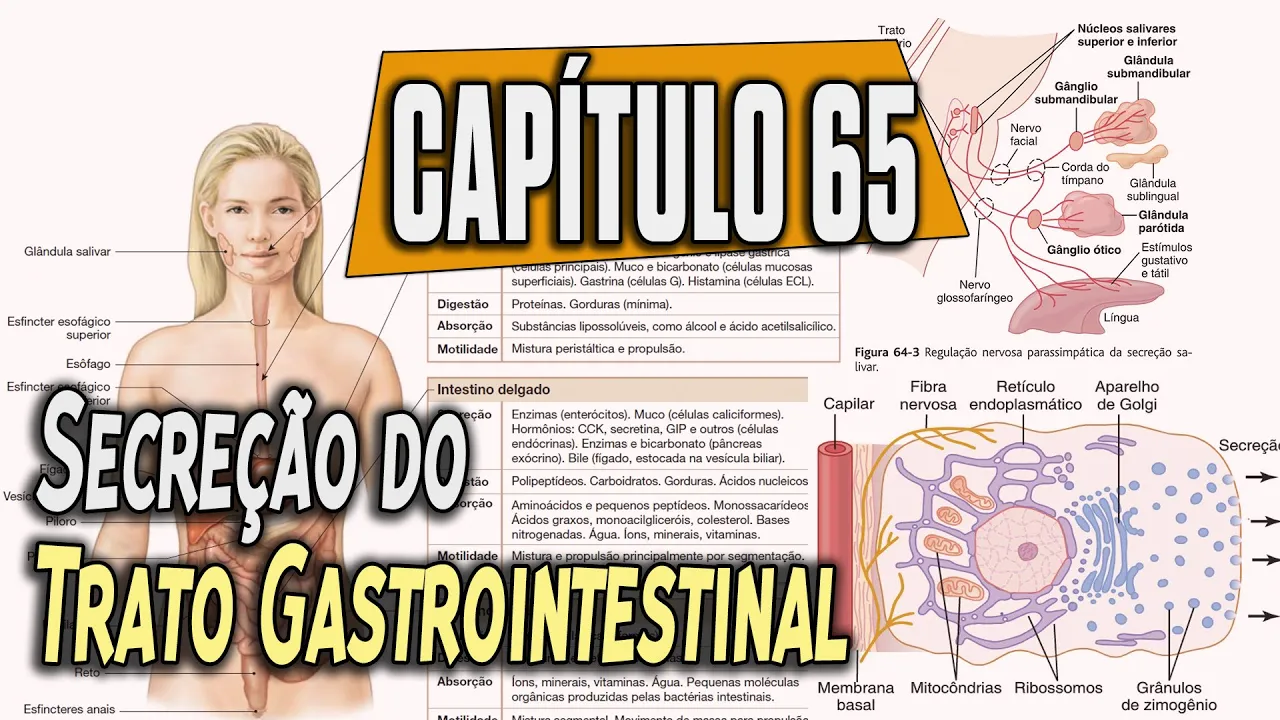
- A detailed description is provided regarding secretory cells, highlighting their structure including nuclei, endoplasmic reticulum, mitochondria for ATP production, and Golgi apparatus for enzyme processing.
- Exocytosis is explained as a mechanism by which secretory vesicles fuse with cell membranes to release contents outside the cell.
Histological Types of Secretory Cells
- Various anatomical types of glandular cells are discussed: goblet cells (mucus producers), specialized secretory cells in intestinal crypts, and gastric glands producing hydrochloric acid.
- Salivary glands, pancreas, and liver are mentioned as key contributors to digestion through enzyme production and bile secretion for fat emulsification.
Enzymatic Functions in Digestion
- The pancreas produces several digestive enzymes (proteolytic, amylolytic), while saliva contains amylase for carbohydrate breakdown.
- Emphasis is placed on how these enzymes facilitate digestion at various stages within the gastrointestinal tract.
Absorption Processes
Digestive Processes in the Stomach and Intestines
Overview of Gastric Secretions
- The stomach secretes hydrochloric acid from parietal cells, pepsinogen and gastric lipase from chief cells, bicarbonate from surface mucous cells, gastrin from G cells, and histamine from enterochromaffin-like cells.
Digestion in the Stomach
- Protein digestion occurs primarily in the stomach; minimal fat digestion takes place here. The stomach also absorbs lipid-soluble substances like alcohol and acetylsalicylic acid (aspirin).
Mixing and Propulsion Movements
- The stomach performs mixing movements to ensure hydrochloric acid contacts all food particles, facilitating digestion before it moves to the small intestine.
Activation of Pancreatic Enzymes
- Enterokinase, released by enterocytes in the small intestine, is crucial for activating pancreatic enzymes that are secreted in inactive forms to prevent self-digestion.
Role of Bile and Hormones
- Hormones such as cholecystokinin and secretin are released into the small intestine along with bile produced by the liver. These aid in digesting proteins, carbohydrates, fats, and nucleic acids.
Absorption Mechanisms
- The small intestine is responsible for absorbing nutrients including amino acids (from proteins), monosaccharides (from carbohydrates), fatty acids (from lipids), vitamins, minerals, water, and organic molecules produced by intestinal bacteria.
Motility of the Small Intestine
- Segmentation movements mix contents within the small intestine while peristalsis propels them forward.
Functions of the Large Intestine
- The large intestine mainly absorbs ions, vitamins, minerals, water; it has limited digestive functions except for bacterial fermentation.
Mass Movement in Colon
- Unique mass movement contractions occur only in the colon to propel contents forward through distension.
Stimulating Digestive Glands
- Digestive gland stimulation can occur via protein contact with gastric cells leading to gastrin release which increases hydrochloric acid production.
Response to Chyme Arrival
- When chyme enters the small intestine, it triggers pancreatic enzyme secretion along with bicarbonate to neutralize gastric acid for optimal enzyme function.
Understanding Hormonal and Enzymatic Functions in Digestion
The Role of Hormones and Enzymes
- The stomach's distension from food intake stimulates hormone production, which subsequently triggers the secretion of gastric acid.
- Hormones travel through the bloodstream to capillaries, while enzymes and gastric juices act directly within the lumen of the digestive tract to break down food.
- It's crucial to differentiate between hormones (which do not contact food directly) and enzymes (which interact with food for digestion).
Autonomic Nervous System Influence
- The autonomic nervous system, comprising sympathetic and parasympathetic components, regulates digestive secretions; parasympathetic stimulation increases secretion levels.
- Brunner's glands produce alkaline mucus in the duodenum for protection against acidity, highlighting their role in maintaining a balanced pH.
Interaction Between Sympathetic and Parasympathetic Systems
- Both systems can increase secretion but operate differently; parasympathetic activity significantly boosts secretion compared to sympathetic activity.
- When both systems are active simultaneously, they inhibit each other’s effects on secretion due to conflicting signals.
Effects of Stress on Digestion
- Sympathetic activation can lead to decreased digestive secretions when it counteracts parasympathetic stimulation during stress or adrenaline release.
- While both systems have dual effects on secretion, sympathetic activity primarily serves as an inhibitor when competing with parasympathetic functions.
Gastrointestinal Secretions and Absorption
- Gastrointestinal hormones also play a significant role in stimulating secretions; understanding these interactions is essential for grasping digestive processes.
- The body secretes approximately 6.7 liters of water daily into the digestive tract for digestion, emphasizing the importance of fluid balance in gastrointestinal health.
Mechanisms Behind Diarrhea
- In cases like bacterial infections (e.g., salmonella), increased water secretion leads to diarrhea as the body attempts to flush out pathogens while still digesting food.
Understanding Diarrhea and Electrolyte Imbalance
The Impact of Diarrhea on Hydration
- Diarrhea can lead to significant fluid loss, resulting in an inability to absorb nutrients effectively. This condition often causes electrolyte imbalances due to the secretion of water and electrolytes.
- Patients experiencing severe diarrhea may face risks such as hyponatremia (low sodium levels) and hypokalemia (low potassium levels), as they lose essential solutes through excessive secretions.
Salivary Glands and Their Functions
- Saliva production is substantial, averaging about 1 liter per day, with a pH level between 6 and 7, which is crucial for oral health.
- The pH of saliva is neutral to weakly acidic compared to gastric acid, which has a much lower pH. This difference plays a role in digestion and protecting the stomach lining.
Gastric Acidity and Saliva Production
- Increased acidity in conditions like gastritis stimulates saliva production, which helps neutralize gastric acid when swallowed.
- The body's response aims to protect the stomach from further damage by maintaining a more neutral environment through increased salivation.
Digestive Secretions Overview
- Daily gastric secretion averages around 1.5 liters with a highly acidic pH of approximately 0.8, while pancreatic secretions are alkaline at about pH 8.3 due to bicarbonate production.
- The small intestine secretes around 1.8 liters daily; its secretions are also alkaline, aiding in digestion and nutrient absorption.
Composition of Saliva
- Saliva contains various components: parotid glands produce serous secretion; submandibular and sublingual glands produce both serous and mucous types.
- Potassium concentration in saliva is notably higher than that in plasma, playing an important role in oral health and enzymatic activity during digestion.
Importance of Mastication
- Proper chewing (mastication), ideally around 20 times before swallowing, enhances the effectiveness of salivary enzymes like amylase (ptyalin).
- Encouraging longer mastication can improve carbohydrate digestion before food reaches the stomach, reducing digestive workload on pancreatic enzymes.
Understanding Salivary Function and Oral Hygiene
Mechanisms of Ion Absorption and Secretion
- Sodium absorption leads to passive chloride uptake, which is essential for maintaining electrolyte balance in the body.
- Saliva plays a crucial role in oral hygiene and immunity by containing antibodies that protect against bacteria present in the mouth.
- Dental health is linked to overall health; infections from dental issues can predispose patients to cardiovascular diseases.
Importance of Oral Hygiene
- The presence of cavities can lead to serious cardiovascular infections, highlighting the need for regular dental check-ups.
- Saliva not only washes away food particles but also has bactericidal properties due to enzymes like lysozyme that attack bacteria.
Regulation of Salivary Secretion
- Saliva contains proteins and enzymes that help destroy bacteria, contributing to oral health.
- The salivary secretion process is regulated by centers located in the brainstem, with higher appetite leading to increased saliva production.
Neural Control of Salivation
- Increased appetite triggers salivation as a preparatory response for food intake, enhancing digestion through enzyme action.
- Sensory stimuli such as sight or smell of food can stimulate gastric acid production even before eating occurs.
Pathways Involved in Taste and Salivation
- When food contacts the tongue, tactile stimulation activates cranial nerves (VII - Facial and IX - Glossopharyngeal), initiating salivation responses.
- These nerves relay information to the nucleus tractus solitarius, connecting sensory input with salivary output mechanisms.
Integration of Responses for Digestion
- The facial nerve contributes primarily to salivation rather than respiration, indicating distinct neural pathways for these functions.
Next Class Focus: Gastrointestinal System
Overview of Upcoming Lessons
- The instructor expresses hope that the audience enjoyed the current lesson and looks forward to the next class.
- The next session will concentrate on the gastric part of the gastrointestinal system.
- The instructor plans to divide this topic into three parts for clarity and depth.
- The third part is expected to cover pancreatic functions, gallbladder, and small intestine.