Luminotecnia Conceptos Básicos versión 2.0
What is Luminotechnics?
Introduction to Luminotechnics
- Luminotechnics is the study of various methods for producing light, controlling it, and applying it for specific purposes.
- It involves understanding fundamental magnitudes since light influences human vision and requires measurement in specific units.
Fundamental Magnitudes of Light
- Flux Luminoso (Φ): Measured in lumens (lm), represents the total amount of visible light emitted by a source.
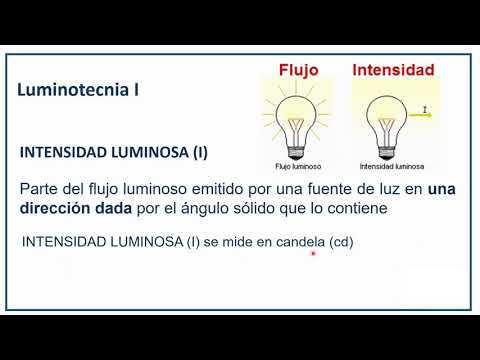
- Intensidad Luminosa (I): Measured in candelas (cd), indicates the power emitted by a light source in a particular direction.
- Iluminancia (E): Measured in lux (lx), refers to the amount of light that falls on a surface area.
- Luminancia (L): Measured in candelas per square meter (cd/m²), describes how much light is reflected or emitted from a surface towards an observer.
Understanding Efficacy and Efficiency
Eficacia Luminosa
- Defined as the ratio between luminous flux emitted by a lamp and its electrical consumption measured in watts.
- The formula for efficacy is: Eficacia Luminosa = Flujo Luminoso / Potencia Consumida.
Eficiencia de la Luminaria
- This measures the relationship between luminous flux output from a luminaire and total power consumed, including losses due to reflectors or auxiliary circuits.
Comparative Analysis of Lighting Sources
Example Comparisons
- A 15-watt energy-saving bulb has an efficacy of 60 lumens per watt compared to an 8-watt LED bulb with 112.5 lumens per watt, indicating higher efficiency for LEDs.
Losses and Efficiency Calculation
- In scenarios where lamp power is 150 watts with additional losses, efficiency can be calculated considering these factors leading to effective output measurements.
Lighting Methods Overview
General Lighting Techniques
- General lighting provides uniform illumination across an area; luminaires are regularly placed on ceilings for even distribution.
Localized Lighting Techniques
- General localized lighting focuses on specific areas like museums or retail spaces where certain items need highlighting while keeping other areas dimmer.
Types of Illumination
Direct vs. Indirect Illumination
- Direct illumination directs most light downwards onto work areas, while semi-direct allows some upward emission as well.
Diffuse Illumination Types
Lighting Techniques and Recommendations
Types of Lighting
- The workspace can utilize semi-indirect lighting, where 10% to 40% reaches the work area while 69% is directed upwards. Indirect lighting illuminates nearly 90% towards the ceiling.
- Soft and elegant light types include indirect lighting, which directs light upward, and diffuse lighting that uses translucent materials to scatter light in all directions.
Recommended Illumination Levels
- General residential illumination should average around 300 lux for kitchens, with localized lighting of 500 to 600 lux for areas like portals.
- Specific areas such as bathrooms require angled lighting at about 200 lux, while food preparation areas should have between 100 to 200 lux; reading areas need up to 500 lux.
- Commercial spaces demand higher illumination levels (300 to 600 lux), especially in display windows where it can reach between 1,000 to 3,000 lux.
Office and Meeting Room Lighting
- Administrative offices should maintain a general illumination level of approximately 400 to 700 lux. Drawing tables may require localized lighting ranging from 600 to 1,500 lux.
- Meeting rooms typically need around 200 to 350 lux; additional external sources are recommended for task-specific areas.
Educational and Industrial Lighting Standards
- In educational settings, general illumination values are high; precision tasks may require between 600 and up to over a thousand lux depending on the activity.
Color Temperature of Light
- Color temperature is measured in Kelvin (K); warm light below approximately 3,300 K has yellowish tones associated with sunlight or fire.
- Neutral white light ranges from about 3,300 K to over a thousand K; cold light exceeds this range (5,000 K -6,500 K), often seen in fluorescent tubes.
Effects of Different Light Temperatures
- Warm lights create relaxing environments suitable for bedrooms or living rooms. Cold lights keep individuals alert—ideal for offices or study spaces.
- Neutral lights serve well in public spaces due to their balanced nature.
Practical Applications of Lighting Types
- Quality ambient lighting is essential when using darker colors within an environment. Daylight or neutral tones enhance alertness in bright-colored settings.
Types of Indoor Luminaires
- Incandescent bulbs emit light through heated filaments but are less efficient compared to modern alternatives.
Understanding LED Technology and Light Distribution
Overview of LED Technology
- LED technology, or Light Emitting Diode, is recognized for its high energy efficiency, producing more light with less energy consumption.
- Currently, LEDs are widely used across various sectors in residential settings due to their effectiveness and recommended usage.
Light Distribution Diagrams
- Flow diagrams typically accompany data sheets for luminaires, illustrating how the light source emits illumination around it.
- A specific cut is made at 0 degrees pointing directly downward to analyze the light distribution angle surrounding the luminaire.
Analyzing Light Emission Angles
- The analysis involves varying angles concerning the circumference around the luminaire to understand its emission pattern.