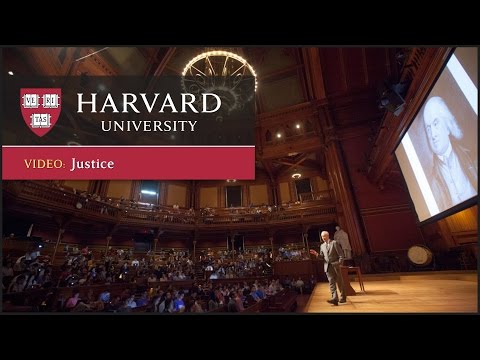
Justice: What's The Right Thing To Do? Episode 02: "PUTTING A PRICE TAG ON LIFE"
Funding Information
The program's funding sources are disclosed at the beginning of the video.
Jeremy Bentham and Utilitarianism
- Bentham's background and dedication to jurisprudence and moral philosophy.
- Introduction to Bentham's utilitarian philosophy focusing on maximizing general welfare or collective happiness.
- Explanation of how pain and pleasure govern individuals, leading to the principle of maximizing utility for the greatest good.
Utilitarian Logic in Practice
Application of utilitarian logic through cost-benefit analysis in real-world scenarios.
Cost-Benefit Analysis Example: Smoking Tax Increase
- Discussion on a cost-benefit analysis regarding smoking in the Czech Republic.
- Positive effects of increased tax on smoking including health care savings and government revenue.
Ford Pinto Case Study
- Overview of the Ford Pinto case involving a cost-benefit analysis for safety improvements.
Cost-Benefit Analysis and Utilitarian Calculus
The discussion revolves around defending cost-benefit analysis in the face of a counterexample that challenges its application to human life valuation within utilitarian calculus.
Defending Cost-Benefit Analysis
- Julie argues that assigning a dollar value to human life overlooks emotional losses and suffering, emphasizing the inadequacy of monetary quantification.
- Julie suggests that analyzing human life monetarily is inappropriate, advocating against placing any numerical value on it.
Adjusting for Inflation and Disagreements
- Voicheck proposes adjusting for inflation when determining the value of human life, highlighting the need for generosity in such assessments.
- Voicheck disagrees with Julie, asserting the necessity of assigning a number to human life for decision-making purposes despite ethical concerns.
Application of Cost-Benefit Analysis
- Discussion ensues on the necessity of cost-benefit analysis for corporate profitability and societal benefits, emphasizing its role in decision-making processes.
- Raul mentions a study on cell phone use while driving, prompting debate on balancing economic benefits with safety concerns through cost-benefit analysis.
Critiques of Utilitarian Approach
Critiques are raised against utilitarianism's focus on maximizing utility as the basis for policy and law decisions.
Challenging Utilitarian Logic
- Concern is expressed regarding prioritizing majority interests over minority needs, questioning the fairness and ethical implications of maximizing utility solely based on numbers.
- Anna voices worries about minority representation and fair treatment within utilitarian frameworks, highlighting potential injustices faced by marginalized groups.
Response to Minority Concerns
- Youngda argues that individual values remain constant regardless of group size, suggesting that decisions must prioritize overall benefit even if it affects minorities negatively.
Utilitarianism and Minority Rights
The discussion delves into concerns about utilitarianism violating the rights of minorities and individuals, emphasizing the importance of respecting minority preferences and rights within a utilitarian framework.
Examples of Concerns with Utilitarianism
- In scenarios like the shipwreck case, even if an individual is in the minority, they still have a right to live.
- The minority members should not have their rights traded off for the greater good or utility of the majority.
- Illustration from ancient Rome where Christians were thrown to lions questions utilitarian calculus regarding individual suffering versus collective pleasure.
Aggregating Utility and Individual Rights
This segment explores objections to utilitarianism related to its respect for individual rights and challenges in aggregating all values into a single measure.
Objections to Utilitarianism
- Two main objections: one concerning respect for individual/minority rights, the other questioning aggregating all values into a uniform measure.
- Discussion on whether it's feasible to translate all values into monetary terms as attempted by a psychologist in the 1930s through surveys.
Measuring Values and Consequences
Thorndike's study on measuring values through experiences raises questions about capturing all human concerns under a single measure in utilitarianism.
Thorndike's Study Insights
- Thorndike's survey on unpleasant experiences reveals varying valuations, challenging Bentham's idea of uniform value measurement.
- Examples like pulling out teeth or living on a farm highlight diverse valuations that may not align with uniform measures.
Challenges to Utilitarian Theory
The discussion concludes by questioning whether certain valued aspects can be quantified uniformly, impacting utilitarian moral theory.
Implications for Utilitarian Theory
- Reflection on whether cherished values like life or personal experiences resist being captured uniformly challenges utilitarian principles.
The Debate on Utilitarianism and Values
The discussion revolves around the translation of values into utilitarian terms, focusing on a specific case at an all-women college in England.
Translation of Values into Utilitarian Terms
- Rules against overnight male guests at women's colleges were rarely enforced by the 1970s.
- Debate arose in the late 1970s at St., an all-women college, regarding relaxing rules on overnight male guests.
- Traditionalist faculty members opposed change but framed their arguments in utilitarian terms to avoid embarrassment.
- A compromise was reached allowing each woman three overnight male guests per week with a fee to cover costs.
Challenges to Utilitarianism: Aggregating Values and Preferences
This segment delves into concerns about aggregating values and preferences within utilitarianism, questioning the uniformity and commensurability of values.
Weighing Preferences
- Criticism arises regarding the assumption of commensurability of all values and preferences within utilitarianism.
- The debate centers on distinguishing between higher and lower pleasures, challenging the idea of treating all preferences equally.
Qualitative Distinctions in Pleasures: Benthamite vs. Alternative Views
The discourse contrasts Benthamite views on pleasures solely based on intensity and duration with arguments advocating for qualitative distinctions in pleasures.
Higher vs. Lower Pleasures
- Bentham's perspective emphasizes intensity and duration as criteria for evaluating pleasures.
- Questioning arises about whether certain pleasures can be deemed intrinsically higher or worthier than others, challenging the refusal to make qualitative distinctions.
John Stuart Mill's Response to Utilitarianism Critiques
John Stuart Mill's attempt to address objections to utilitarianism through humanizing its principles is explored, emphasizing individual rights and higher pleasures.
John Stuart Mill's Approach
- Mill sought to expand utilitarian calculus to incorporate humanitarian concerns like individual rights and distinctions between higher and lower pleasures.
Higher vs. Lower Pleasures
The discussion revolves around John Stuart Mill's concept of distinguishing qualitatively higher pleasures from lower ones based on preferences and experiences.
Understanding Mill's Distinction
- Mill proposes that the distinction between higher and lower pleasures is determined by individuals' preferences after experiencing both types of pleasures.
- John highlights that according to Mill, the test for higher pleasure lies in individuals' actual experiences and preferences.
- In Chapter two, Mill emphasizes that a pleasure is considered higher if most people who have experienced both types distinctly prefer it, regardless of any moral obligations.
- This preference-based approach forms the basis for differentiating between desirable pleasures.
Evaluating Utilitarian Arguments
- A debate ensues regarding the success of arguing within utilitarian terms for distinguishing between higher and lower pleasures.
- Participants are prompted to share their views on whether Mill's argument effectively establishes a qualitative hierarchy among pleasures.
Experimenting with Pleasure Preferences
An experiment is conducted using excerpts from popular entertainment to explore participants' preferences and perceptions of pleasure.
Analyzing Excerpts
- Three short excerpts are presented: a Hamlet soliloquy, Fear Factor introduction, and The Simpsons clip.
- Each excerpt offers a distinct form of entertainment ranging from Shakespearean drama to reality TV and animated comedy.
- Participants express varied preferences towards the presented excerpts, showcasing individual inclinations towards different forms of entertainment.
- The majority favor The Simpsons over Shakespeare, raising questions about the perceived value and enjoyment derived from each experience.
Debating Pleasure Worthiness
Participants engage in a debate regarding the worthiness and nobility of different forms of pleasure experiences.
Assessing Pleasure Value
- Discussions focus on determining which form of entertainment is deemed "worthiest" or provides the highest experience.
- Participants express contrasting opinions on whether cultural conventions or personal inclinations influence perceptions of pleasure value.
- Considerations extend beyond mere enjoyment to contemplate deeper intellectual engagement versus immediate gratification in assessing pleasure worthiness.
- Deliberations highlight the role of societal norms in shaping perceptions of artistic merit and pleasurable experiences.
Preference vs. Cultural Influence
Participants delve into how personal preferences intersect with cultural influences when evaluating different forms of art and entertainment.
Balancing Personal Preference with Cultural Influence
- Individuals reflect on how external factors such as cultural teachings impact their perceptions of artistic value compared to personal enjoyment.
- Discussions reveal tensions between accepting societal judgments on art versus forming independent opinions based on personal experiences and inclinations.
Long-Term Satisfaction vs. Immediate Gratification
Contemplation shifts towards long-term satisfaction derived from deep intellectual pursuits versus immediate gratification offered by various forms of entertainment.
Long-Term Fulfillment Analysis
- Participants weigh the enduring satisfaction gained from profound intellectual engagement against transient amusement provided by popular media content.
New Section
In this section, the discussion revolves around the preference for higher pleasures over intense but momentary pleasures, as well as an exploration of Mill's theory on distinguishing between higher and lower pleasures.
Preference for Higher Pleasures
- Human preference for higher pleasure over intense but momentary pleasure.
- : Majority would choose to be a human experiencing higher pleasure over a rat with intense pleasure momentarily.
Mill's Theory on Higher Pleasures
- Mill's theory suggests that when asked, most people would opt for engaging in higher pleasures.
- : Discussion on how Mill's theory aligns with people's inclination towards higher pleasures.
Distinguishing Higher Pleasures
- The challenge of distinguishing between higher and lower pleasures within a utilitarian framework.
- : Highlighting the difficulty in discerning higher pleasures under utilitarianism.
Distinguishing Higher from Lower Pleasures
This section delves into John Stuart Mill's attempt to differentiate between higher and lower pleasures, emphasizing the cultivation and appreciation required for recognizing these distinctions.
John Stuart Mill's Perspective
- Quote from John Stuart Mill regarding being dissatisfied as a human versus satisfied as a pig or fool.
- : Exploring the idea that it is better to be dissatisfied as a human than satisfied as a pig or fool.
Appreciating Higher Pleasures
- Importance of education in appreciating higher pleasures like visiting an art museum compared to passive activities at home.
- : Discussing how experiences shape our understanding of different levels of pleasure.
Cultivation of Preferences
- Emphasizing how education and cultivation lead individuals to prefer higher over lower pleasures.
- : Explanation of how cultivated preferences influence choices between high and low pleasures.
Justice and Individual Rights
This section explores the relationship between justice, individual rights, and utilitarian reasoning according to John Stuart Mill's perspective.
Justice Grounded in Utility
- Discussion on justice grounded in utility being paramount in morality according to Mill.
- : Explanation of how justice based on utility holds significant moral weight.
Sacredness of Justice
- Justifying justice as sacred due to its social utility implications rather than departing from utilitarian principles.
- : Elaboration on why justice is considered sacred within utilitarian reasoning.
Jeremy Bentham: Utilitarianism Pioneer
This section provides insights into Jeremy Bentham’s unique approach to preserving his body posthumously aligned with his philosophical beliefs.
Bentham’s Philosophical Legacy
- Description of Bentham’s request to preserve his body for anatomical study post-mortem.
- : Detailing Bentham’s unconventional decision regarding his physical remains.
Philosophical Symbolism
- Significance behind preserving Bentham’s physical presence to inspire future generations based on his philosophy.