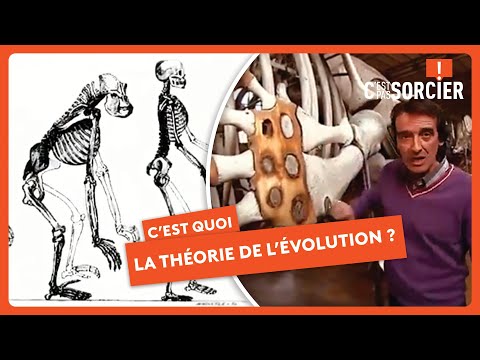
La théorie de l'Évolution, c'est quoi ? - C'est pas sorcier
The Evolution of Species
Introduction to Evolution
- The conversation begins with a discussion about monkeys being our cousins, referencing a common ancestor and the theory of evolution.
- An invitation is extended to explore the topic further at the Muséum d'histoire naturelle in Paris.
Historical Context of Evolutionary Thought
- Life on Earth has existed for approximately 3.5 billion years, with species continuously evolving and multiplying; millions exist today across various categories like mammals, birds, and reptiles.
- Early scientists noted similarities between species through skeletal studies; for example, comparing whale fins to human hands reveals structural resemblances.
Classification and Early Theories
- In the 18th century, Swedish scientist Carl Linnaeus classified thousands of animals and plants but believed in a hierarchy from humans to lesser beings.
- Georges Cuvier founded comparative anatomy but maintained that each species was created by divine intervention without evolution.
Lamarck's Contribution
- Jean-Baptiste Lamarck proposed in 1800 that species transform over time based on environmental adaptations; he suggested animals could modify their organs during their lifetime.
- He used examples like camels developing humps for water storage and giraffes elongating their necks to reach higher foliage as evidence of adaptation.
Critique of Lamarck's Theory
- While Lamarck’s ideas were innovative, they faced criticism; for instance, it was argued that physical changes from activities (like muscle development in athletes) do not pass on genetically.
Darwin's Revolutionary Ideas
Darwin's Observations
- Charles Darwin embarked on a five-year voyage around the world as a naturalist aboard the Beagle (1825–1831), observing how species adapted to different environments.
- His experiences included studying animal breeding practices which influenced his understanding of natural selection.
Publication of "On the Origin of Species"
- After two decades of research, Darwin published "On the Origin of Species" in 1859, challenging existing beliefs about species origins while agreeing with Lamarck on transformation over time.
Natural Selection Explained
- During his studies in the Galapagos Islands, Darwin observed variations among finches based on their environments—specifically beak sizes suited for different food sources.
Key Elements Introduced by Darwin
- Darwin introduced natural selection as a mechanism where nature favors individuals best suited for survival; he emphasized randomness in traits such as neck length among giraffes.
Darwin's Theory of Evolution and Genetic Mutations
The Role of Genetic Mutations in Evolution
- Darwin was unaware that genetic mutations are the source of variations among species, which nature selects for adaptation to their environments.
- Traits such as neck length in giraffes are genetically inherited; longer-necked individuals access food more easily, leading to better survival and reproduction rates.
Controversy Surrounding Darwin's Ideas
- Upon its release, Darwin's work gained traction in scientific circles but faced backlash from religious institutions who rejected the idea of human ancestry linked to apes.
- Creationists continue to oppose evolutionary theory, promoting concepts like Intelligent Design, suggesting a creator guides evolution rather than it being solely a natural process.
Advances in Genetics Supporting Evolution
- Darwin lacked genetic tools during his time; however, advancements in genetics during the 20th century provided evidence supporting evolution through DNA analysis.
- DNA sequencing allows scientists to determine the order of nucleotides (A, T, G, C), revealing genetic differences between individuals.
Mechanisms of Mutation Transmission
- Genetic errors or mutations can occur in any cell but must happen in reproductive cells (sperm or egg) to be passed on to offspring.
- For example, male and female butterflies share their genetic material through chromosomes when reproducing.
The Impact of Environmental Changes on Survival
- During cell division, DNA replication may introduce small errors that lead to mutations affecting traits like color.
- A mutation resulting in black butterflies instead of white ones may not always confer an advantage depending on environmental factors like tree bark color.
Natural Selection and Cooperation Among Species
- While darker butterflies might struggle against light backgrounds initially, they could benefit if environmental changes favor their coloration due to pollution darkening tree trunks.
- Evolution is not just about competition; cooperation also plays a role. For instance, clownfish clean sea anemones while receiving protection from predators.
Evolution and Cooperation in Nature
The Role of Insects in Plant Reproduction
- Many flowers reproduce with the help of insects that collect nectar, inadvertently transporting pollen.
- Within species, cooperation and social relationships are observed; support for weaker individuals is naturally selected.
Evolutionary Characteristics and Social Behavior
- Cooperative behaviors are evolutionary traits that enhance survival against environmental challenges.
- Highly social animals, like termites, exhibit self-sacrifice to protect their colonies, emphasizing species survival over individual survival.
Understanding Phylogeny
- Species evolution is widely accepted; phylogeny studies the relationships between animals and their common ancestors.
- Paleontologists study fossils to understand these ancestral connections by comparing ancient remains with current species.
Fossil Analysis Techniques
- Paleontologists search for fossils in the field, comparing them to modern forms (e.g., hippos).
- Fossils can date back millions of years; for instance, a 10-million-year-old hippo fossil shows adaptations for an amphibious lifestyle.
Molecular Phylogeny Insights
- Molecular phylogeny involves comparing DNA sequences to trace evolutionary histories.
- Researchers extract DNA from living species or well-preserved fossils to analyze genetic similarities and differences.
Surprising Genetic Relationships
- DNA analysis can reveal unexpected familial links among species previously thought unrelated (e.g., cetaceans are closely related to hippos).
- By combining paleontology with molecular data, scientists can estimate when certain species appeared based on genetic comparisons.
Ancestral Connections Among Birds
- Initial appearances may mislead about relationships; genetic analysis showed closer ties between mews and kiwis than between mews and ostriches.
- Scientists determined a common ancestor existed 68 million years ago by quantifying DNA changes over time.
Tracing Life's History on Earth
- Life began approximately 3.8 billion years ago from unicellular organisms similar to bacteria.
- Multicellular life emerged around 540 million years ago, leading to the first animals in oceans before colonizing land. Dinosaurs dominated until their mass extinction 65 million years ago due to a meteor impact.
The Evolution of Humans and Their Relatives
The Survival of Species
- Birds are the descendants of the few dinosaur species that survived a massive extinction event, alongside small mammals that proliferated and diversified.
- New species emerged post-extinction, including lemurs, monkeys, and ultimately humans. Paleontology and phylogeny have enhanced our understanding of life's extensive history.
Understanding Human Evolution
- Humans are not the pinnacle of evolution but merely a step in an ongoing process; it's crucial to recognize this perspective.
- Our closest relatives include gorillas and chimpanzees, sharing a common ancestor with them.
Key Ancestors in Human Lineage
- Significant ancestors like Australopithecus, Homo habilis, Homo erectus, Neanderthals, and Cro-Magnon exist within our evolutionary tree.
- The oldest known human ancestor is Thumaï, dating back approximately 7 million years. The lineage diverged into Australopithecus and early human branches around 3 to 4 million years ago.
Distinguishing Between Ancestors and Relatives
- While Neanderthals share a common ancestor with modern humans, they are not direct ancestors but rather distant cousins.
- All humans belong to one species—Homo sapiens—despite variations in skin color due to environmental adaptations.
Ongoing Human Evolution
- Populations consuming milk exhibit different evolutionary paths; this adaptation illustrates how humans continue evolving based on dietary practices over the last 10,000 years.
- Infants digest breast milk using an enzyme called LPH; however, most adults lose this ability as they age unless their diet includes significant dairy.
Genetic Adaptations in Modern Humans
- A mutation allows some adults to maintain LPH activity into adulthood; this trait is prevalent among Northern European populations where dairy farming is common.
- Despite technological advancements reducing natural selection pressures on humans today, evolution persists. Speculation exists about future human traits as certain attributes may become obsolete.
Sexual Selection's Role in Evolution
- Traits such as hairiness may be influenced by sexual selection criteria varying across cultures; preferences can lead to differential reproduction rates affecting gene transmission.
Resistance to Environmental Changes
- Current human features will likely remain stable for thousands of years due to medical advancements mitigating evolutionary disadvantages (e.g., dental issues).
Rapid Mutations Observed in Other Species
- Research on mosquitoes near Montpellier shows rapid genetic mutations due to insecticide exposure since the 1960s.
- Insecticides do not create mutations but select for existing resistant mutants within mosquito populations.
The Impact of Insecticides on Evolution
Resistance and Adaptation
- When changing insecticides, initially resistant mutants will die off; however, new mutations will quickly arise, leading to the development of new resistant mosquito populations.
Human Influence on Evolution
- Human actions significantly impact evolution on Earth, often negatively. Rapid environmental changes hinder species' adaptation abilities, contributing to a massive extinction crisis.
Biodiversity and Population Size
- A smaller population size leads to reduced genetic diversity. It is crucial to preserve biodiversity and maintain large animal populations to protect the evolutionary richness developed over millions of years.
The Nature of Evolution
- Evolution is primarily driven by chance and mutations; humans are not the pinnacle of this process. This raises concerns about the potential extinction of humanity in the future.
Conclusion Remarks
- The discussion concludes humorously with a reminder that while humanity's fate is uncertain, time for the current conversation is running out.