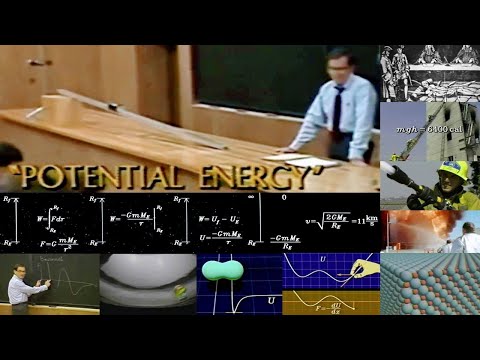
Energía Potencial (Universo Mecánico 14)
Exploring the Intersection of Science and Fantasy
The Mysterious Zone Between Science and Fantasy
- The discussion begins with the concept of potential energy, highlighting a mysterious area between science and fantasy that has historically inspired new ideas.
- Ideas like music of the spheres, alchemy, and astrology have influenced human imagination for centuries, impacting both science and scientists.
Roger Boscovich: A Visionary Thinker
- Roger Boscovich (1711), an imaginative figure educated as a Jesuit, contributed significantly to scientific thought despite not being a scientist in the traditional sense.
- He proposed that matter is composed of atoms and introduced the idea of forces acting between them, illustrating this with diagrams showing attractive and repulsive forces.
Forces Between Atoms
- Boscovich theorized that when atoms are far apart, they experience an attractive force; however, this changes to repulsion when they come too close.
- He emphasized that while there may be points where no force acts on atoms, these positions are unstable due to potential shifts in attraction or repulsion.
Stability in Atomic Structures
- The notion of stable equilibrium positions for atoms was introduced; even without force at certain distances, slight movements would lead to either attraction or repulsion.
- This concept suggests that matter is formed by atoms held together by forces in stable configurations—an extraordinary yet scientifically unproven idea at the time.
Energy Dynamics in the Universe
- The lecture transitions into discussing energy dynamics; every atom exists within a framework of stable equilibrium akin to a marble in a bowl.
- Energy is described as one of the most dynamic properties of the universe. It cannot be created or destroyed but can transform into different forms.
Understanding Potential and Kinetic Energy
- Energy manifests in various forms throughout existence. Regardless of its use or misuse, total energy remains constant across the universe.
- Potential energy is defined as stored energy based on position (e.g., gasoline's potential energy), while kinetic energy relates directly to speed.
Transformations Between Energy Forms
- Objects store potential energy based on their position relative to gravitational pull; higher objects possess more gravitational potential energy.
Energy Dynamics in Firefighting
The Relationship Between Potential and Kinetic Energy
- The concept of kinetic energy is linked to the position, similar to how gravitational potential energy depends on an object's height relative to Earth. An atom's potential energy is influenced by its position within matter.
- In combustion, molecules rearrange into forms with lower potential energy. Young firefighters who understand this phenomenon can develop their skills over time.
- A firefighter's primary responsibility is extinguishing fires, which often requires water. This involves converting the water's potential energy into kinetic energy as it reaches the flames.
Work and Energy Transformation
- When water is pressurized, it transforms into kinetic energy as it exits a nozzle at high speed. As water rises against gravity, some kinetic energy converts back into potential energy.
- Humans have always sought to ascend higher; in modern times, some have reached altitudes of 400,000 km. Jules Verne imagined space travel using projectiles propelled by sufficient kinetic energy.
Escaping Earth's Gravitational Pull
- Beyond science fiction, lunar gravity can assist a projectile’s journey. However, leaving Earth without a motor would require significant work against gravity.
- The work needed to lift an object from Earth's surface correlates with gravitational force over distance; this work results in changes in potential energy.
Calculating Energy Requirements for Firefighters
- To escape Earth's gravity entirely, an object must achieve zero potential energy at infinity and sufficient initial kinetic energy (approximately 11 km/s).
- Firefighters rely on their physical strength rather than rockets; they need food-derived energy for climbing stairs or ladders effectively.
Energy Conversion from Food
- The human body derives its necessary work-related energy from food intake. It’s possible to calculate the amount of food required for specific tasks.
- For example, a firefighter weighing 90 kg must convert enough food calories into mechanical work when ascending a building.
Practical Application of Energy Calculations
- Using the formula E_p = mgh, where m is mass (90 kg), g is gravitational acceleration (10 m/s²), and h is height (30 m), we find that the firefighter needs about 27,000 joules of potential energy to climb ten stories.
- This translates roughly to over 6,000 dietary calories needed for such exertion—considering that one dietary calorie equals approximately 1,000 small calories used in physics calculations.
Efficiency of Human Energy Use
- Despite needing substantial caloric intake for basic functions like breathing and metabolism, only a small fraction contributes directly to mechanical work during activities like climbing.
Energy Transformation and Equilibrium in Physics
Energy Conversion in Athletes
- The pole vaulter converts kinetic energy into potential energy, which is stored in the pole. This potential energy then transforms back into kinetic energy as the athlete clears the bar.
- Humans continuously convert food energy into various forms of energy; however, only a fraction becomes kinetic or potential during maximum exertion.
Work and Energy Dynamics
- Work is defined as muscular force applied over a distance, transferring energy from one system (the human body) to another (kinetic or potential forms).
- Climbing requires balance; in physics, equilibrium occurs when all forces are balanced. However, stability involves more than just balance—it includes preventing slips or falls.
Types of Equilibrium
- Stable equilibrium can be visualized on a potential energy graph where forces drive objects toward lower potential positions. The slope's steepness indicates the strength of these forces.
- Potential energy can be positive or negative without affecting its impact; zero slope indicates no net force acting on an object, signifying equilibrium.
Atomic Interactions and Stability
- The stable position of hydrogen atoms results from electric forces that attract them at larger distances while resisting compression at closer ranges.
- In climbing scenarios, potential energy decreases as one moves closer to the ground—the lowest point signifies minimal potential energy and maximum stability.
Historical Context of Work and Machines
- When an object returns to its original height, there’s no net change in potential energy despite apparent physical activity—historically machines were used for labor with less voluntary participation.
- Past practices involved coercive methods to extract confessions from prisoners using machines designed to amplify physical stress.
Practical Applications: Inclined Planes and Pulleys
- A practical example involves analyzing a cart on an inclined plane connected by a pulley system with weights influencing movement through frictional forces.
- Students are encouraged to solve problems involving inclined planes and pulleys—a traditional challenge that has historically been viewed as tedious yet essential for understanding mechanics.
Engaging Students in Mechanics
- Despite skepticism about improving global culture through mechanical problem-solving, students are given opportunities to apply learned concepts practically while fostering interest in science.