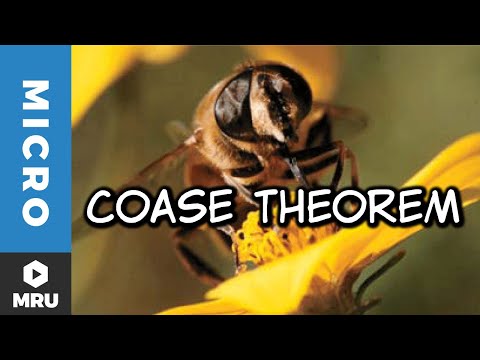
The Coase Theorem
Introduction to Coase Theorem and Market Solutions to Externality Problems
In this section, the speaker introduces the topic of the Coase Theorem and market solutions to externality problems. They explain that the issue with external benefits and costs lies in vague property rights and high transaction costs.
Coase Theorem and Externalities
- The Coase Theorem states that externalities are not inherently problematic because they are external, but rather due to unclear property rights and high transaction costs.
- Property rights in cases of external benefits and costs are often vague and uncertain.
- Transactions costs play a significant role in exacerbating externality problems.
- An example is introduced to illustrate these concepts.
Example of Honey and Pollination Services
- James Meade argued that the market would underprovide honey and pollination services.
- Bees create honey, which is bought and sold in markets at a price.
- Bees also provide pollination services to nearby farmers without being compensated for it.
- Meade considered pollination services as an external benefit.
- Steven Cheung proved Meade wrong by discovering that pollination is a $15 billion industry in the United States. Beekeepers sell their pollination services to farmers, internalizing the benefits.
Low Transaction Costs and Clear Property Rights
- The market for pollination services works because transaction costs are low.
- Bees have limited flight range, allowing agreements between beekeepers and farmers to internalize all externalities.
- Property rights in this case are clear, with the beekeeper owning the honey and the farmer owning the crops that benefit from pollination.
Comparison with Other Externalities
- In other cases of externalities like pollution and flu shots, transaction costs are high and property rights are unclear.
- Pollution poses an external cost, but it is often challenging to determine who bears the cost.
- Uncertainty exists regarding whether factories should pay for pollution or bystanders should pay factories not to pollute.
The transcript provided does not cover the entire video.
New Section
This section discusses external benefits and the difficulty of measuring and assigning value to them. It also explores the concept of property rights and the challenges in determining who should pay for externalities.
External Benefits and Measurement Challenges
- There are external benefits associated with actions like getting a flu shot, as it reduces the likelihood of spreading the flu to others on public transportation.
- The exact number of people who receive these external benefits is uncertain. It could be dozens or even hundreds.
- Measuring the value of these external benefits is challenging.
Property Rights and Payment
- The question arises whether individuals should be paid to get a flu shot or if they should pay others if they choose not to get vaccinated.
- Comparing this situation to pollution, it raises questions about who should bear the cost - the polluter or those affected by pollution.
- Uncertainty exists regarding property rights in these cases, making it difficult to reach agreements on who should pay whom.
Market Efficiency and Externality Solutions
- The Coase Theorem states that under certain conditions (low transaction costs and clear property rights), private bargains can lead to efficient market outcomes even with externalities.
- However, these conditions are often not met in practice, leading to challenges in resolving externality problems through market mechanisms alone.
- The Coase Theorem suggests creating new markets by defining property rights and reducing transaction costs as an alternative approach to addressing externalities.
Next Video
In the next video, tradable permits will be explored as a potential solution for addressing externalities.
The transcript is already in English, so there is no need to respond in a different language.
Turn any video into a summary like this
YouTube links, meetings, lectures — with transcripts, search, and chat.