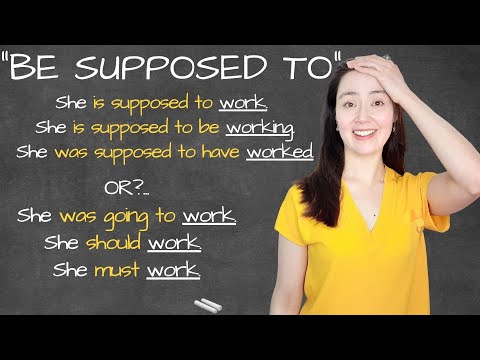
"BE SUPPOSED TO" | Everything you need to know!
Introduction to "Be Supposed To"
In this lesson, the speaker introduces the phrase "be supposed to" and explains its importance. The grammatical structure of the phrase is discussed, along with examples of how it can be used in present and future tenses.
Grammatical Structure
- "Be supposed to" is a set structure that follows the pattern subject + B + base verb.
- The letter D should always be included when writing this phrase, but it is silent when speaking.
- Present B forms can be used to speak about future events.
Personal Obligations vs. External Expectations
- "Should" can be used for personal obligations or choices made by the speaker.
- "Be supposed to" is used for obligations or expectations coming from an external source.
- Examples of external sources include laws, companies, society/culture, etc.
Using "Be Supposed To" for Expected Truths
- "Be supposed to" can also be used when we expect something to be true because we have heard about it.
- Examples include hearing about a good chiropractor or a terrible movie.
Comparison with "Must"
- While both phrases express obligation, "must" is stronger than "be supposed to."
Persuasion and Obligation
This section discusses how persuasion plays a role in obligations and expectations. The example of persuading someone not to do something is given before discussing how external expectations are often beyond our control.
Persuasion in Obligations
- Persuasion can play a role in obligations and expectations.
- Example given: talking someone out of getting a Medusa tattoo on their back.
External Expectations Beyond Our Control
- External sources such as laws, companies, and society/culture can create expectations beyond our control.
- Example given: male employees being expected to wear a tie to work every day.
Recap and Comparison with "Should" and "Must"
This section provides a recap of the main points discussed in the lesson. The differences between "be supposed to," "should," and "must" are compared.
Recap
- "Be supposed to" is a set structure used for obligations or expectations coming from an external source.
- It can also be used when we expect something to be true because we have heard about it.
- Persuasion can play a role in obligations and expectations.
Comparison with "Should" and "Must"
- While all three phrases express obligation, they differ in strength.
- "Should" is used for personal obligations or choices made by the speaker.
- "Must" is stronger than "be supposed to."
Be Supposed To
In this section, the speaker explains how to use "be supposed to" when expectations are not met. The speaker provides examples of negative and positive situations where "be supposed to" can be used.
Using "Be Supposed To"
- "Be supposed to" is used when expectations are not met.
- Examples of negative situations include having fewer students in a class than expected or a projector not working before a presentation.
- Positive situations can also use "be supposed to," such as unexpected additional students joining a class.
Using "-ing" with "Be Supposed To"
In this section, the speaker explains how to use "-ing" with "be supposed to." The speaker provides examples from a novel and emphasizes that using "-ing" emphasizes the action happening in the moment.
Using "-ing"
- Using "-ing" with "be supposed to" emphasizes the action happening in the moment.
- An example from a novel shows how using "-ing" focuses on the action happening now.
- The continuous form is like present continuous and past continuous tenses.
Be Going To vs. Be Supposed To
In this section, the speaker compares and contrasts "be going to" and "be supposed to." The speaker provides examples of both phrases being used interchangeably but also gives an example where they are not interchangeable.
Comparing Phrases
- Both phrases can be used interchangeably when intentions become obligations or expectations become intentions.
- However, there are times when they cannot be interchanged, such as expressing personal preferences or desires.
Formal Structure for Be Supposed To
In this section, the speaker explains how to use the first structure instead of the second structure for "be supposed to" to make it sound more formal.
Formal Structure
- Using the first structure for "be supposed to" with past participle makes it sound more formal.
- The past participle is verb number three, such as "eaten" or "talked."
Passive Voice and "Supposed To"
In this section, the speaker discusses the use of passive voice and "supposed to" in English language. The speaker provides examples from real-life situations to explain how these structures are used.
Examples of Passive Voice and "Supposed To"
- The speaker gives an example of a situation where they were supposed to receive a vegetarian meal on a flight but instead received meat.
- The speaker shares an article from Harvard Business Review about London Airport Heathrow Terminal 5, which was supposed to be the future of travel but did not meet expectations.
- The speaker cites a headline from countrylife.co.uk that reads "Beavers discovered living on River Avon 400 years after they were supposed to have gone extinct." This example shows how the structure is used to express what we think happened in the past but are not sure.
- The speaker talks about how January and February were supposed to have been added by Pneuma Pompilius, the second king of Rome, originally at the end of the year. However, it is unclear when Romans reset the course of the year so that January and February came first again.
How to Use "Supposed To" Correctly
In this section, the speaker explains how to use "supposed to" correctly in English language.
Tips for Using "Supposed To"
- Use "supposed to" when talking about expectations or obligations that were not met.
- Use "supposed to be" when talking about expectations or obligations that are still relevant in the present.
- Use "supposed to have been" when talking about expectations or obligations that were relevant in the past.
Conclusion
In this section, the speaker concludes the video by summarizing the main points discussed and encouraging viewers to practice using "supposed to" correctly in their own English language conversations.