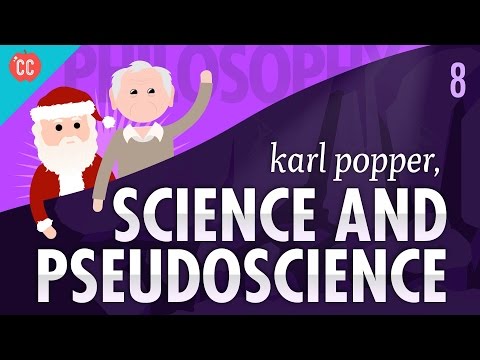
Karl Popper, Science, & Pseudoscience: Crash Course Philosophy #8
Crash Course Philosophy: The Distinction Between Science and Pseudo-Science
Introduction to Key Philosophers
- Crash Course Philosophy is introduced, highlighting the significance of early 20th-century scientific advancements.
- Karl Popper emerges as a critical figure alongside Einstein and Freud, analyzing their methodologies in understanding the world.
Popper's Distinction Between Science and Pseudo-Science
- Popper identifies that not all scientific achievements are equal, leading him to differentiate between science and what he terms "pseudo-science."
- Freud's focus on individual psyche contrasts with Einstein's empirical predictions, showcasing different approaches to knowledge.
Methodologies of Freud vs. Einstein
- Popper observes that Freud could adapt his theories to fit any data, making them unfalsifiable.
- In contrast, Einstein’s predictions were testable; failure would invalidate his theory, demonstrating a riskier approach.
Implications of Popper's Insights
- The ability for theories like Freud’s to be reinterpreted means they lack the rigorous testing characteristic of true science.
- This realization leads Popper to label Freud’s methods as pseudo-science due to their inherent flexibility in interpretation.
Understanding Scientific Methodology
- The traditional view of scientific methodology emphasizes observation without preconceived notions.
- However, Popper argues that everyone has biases influencing what they choose to observe and how they interpret findings.
Confirmation vs. Refutation in Scientific Inquiry
- Observational bias can lead researchers to confirm existing beliefs rather than challenge them.
- Using Santa Claus as an analogy illustrates how evidence can be selectively interpreted; true scientific inquiry should seek refutation instead of confirmation.
Conclusion on Scientific Validity
Understanding Karl Popper's Philosophy of Science
The Nature of Scientific Theories
- Popper asserts that confirmation is only valid if it comes from risky predictions—those that could potentially falsify the theory. He emphasizes that a good scientific theory must be prohibitive, meaning it should rule out certain possibilities.
- To genuinely test a theory, one must attempt to refute it rather than confirm its validity. For example, testing the existence of Santa Claus requires trying to prove he does not exist.
- If evidence shows that Santa is merely a figment (like Dad delivering gifts), then the hypothesis about Santa is destroyed. Popper argues that irrefutable theories lack scientific value.
Testing and Falsification
- One can only confirm the reality of Santa by attempting every conceivable method to disprove him and failing. This includes investigating sightings and behaviors associated with "Santa."
- A true scientist must be willing to abandon disproven beliefs, accepting evidence as it arises. Holding onto myths like Santa after being proven false contradicts scientific reasoning.
The Philosophy of Knowledge
- Popper’s insights extend beyond science; they inform our understanding of knowledge itself. He posits that knowledge involves probability and contingency, urging us to revise beliefs based on new information.
- Unlike Descartes, who sought certainty, Popper believed certainty was unattainable and mental closure undesirable. Remaining open to the possibility of error leads us closer to truth.
Implications for Belief Systems
- The discussion highlights the importance of being receptive to changing one's beliefs in light of new evidence. This openness is crucial for meaningful belief systems.
- Beliefs should be grounded in reason; otherwise, they become arbitrary assertions without justification. This principle will guide future discussions in this course.
Conclusion: Science vs Pseudoscience
- Today’s lesson focused on Karl Popper's distinctions between science and pseudoscience: science seeks to refute while pseudoscience aims for confirmation.
Convierte cualquier video en un resumen como este
Videos de YouTube, reuniones, clases. Con transcripción, búsqueda y chat.