Programs and Programming Languages
Introduction to Programs and Programming Languages
In this section, we will discuss the concept of programs and programming languages. We will explore the different types of programming languages, including machine language, assembly language, and high-level languages.
What are Programs and Programming Languages?
- Programs are sets of instructions that tell a computer what to do.
- Programming languages are used to write programs that computers can understand.
Machine Language
- Machine language is the computer's native language.
- It uses binary code (0s and 1s) to represent instructions.
- Each instruction must be written in machine language before it can be executed.
- Machine language is machine-dependent, meaning it varies among different types of machines.
Assembly Language
- Assembly language was developed to make programming easier than using machine language.
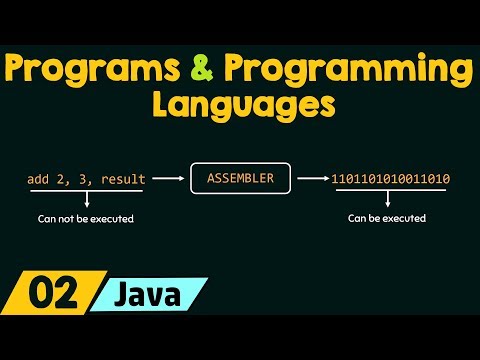
- It is also machine-dependent but introduces keywords for instructions (e.g., add, sub).
- Instructions written in assembly language need to be translated into machine code using an assembler before execution.
High-Level Languages
- High-level languages are a newer generation of programming languages.
- They use English words and are easier to learn and use compared to low-level languages.
- Programs written in high-level languages can run on different machines.
- Each instruction written in a high-level language is called a statement or a source code.
Using High-Level Languages
This section focuses on high-level programming languages. We will explore how they simplify coding compared to assembly and machine code.
Writing Code in High-Level Languages
- High-level programming languages use English words for instructions, making them more readable than low-level languages like assembly or machine code.
- Statements written in high-level languages cannot be directly executed; they need to be translated into machine code first.
Translating High-Level Code
- To execute high-level code, it needs to be translated into machine code using a compiler or an interpreter.
- Compilers translate the entire program at once, while interpreters translate and execute the code line by line.
Example: Adding Two Numbers in Java
- In Java, adding two numbers can be done with a simple statement:
result = 2 + 3;
- The statement is similar to a mathematical expression and uses variables to store values.
- Before execution, this high-level code must be translated into machine code.
Conclusion
This section concludes the discussion on programs and programming languages. It emphasizes the advantages of high-level languages over low-level languages like assembly and machine code.
Advantages of High-Level Languages
- High-level languages are easier to learn and use compared to low-level languages.
- Programs written in high-level languages can run on different machines.
- High-level languages use English words for instructions, making them more readable.
New Section Introduction to Compiler and Interpreter
In this section, we will learn about the difference between a compiler and an interpreter.
Compiler
- A compiler translates source code into machine code.
- The source code is converted into an executable file that can be executed by the computer.
- The entire program is translated into machine code before execution.
- The output or result can be seen after executing the compiled program.
Interpreter
- An interpreter translates each statement of the program into machine code and executes it immediately.
- It does not translate the entire program at once, but rather works on each statement individually.
- Each statement is translated and executed one by one, producing output for each statement.
Difference between Compiler and Interpreter
- Compiler: Translates the entire program into machine code before execution.
- Interpreter: Translates and executes each statement individually, producing immediate output.
This concludes the introduction to compilers and interpreters. Thank you for watching!
[Applause]
Turn any video into a summary like this
YouTube links, meetings, lectures — with transcripts, search, and chat.